Relic point Vietnam
Việt Nam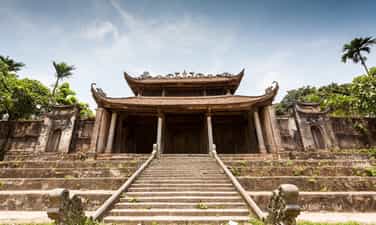
Dinh So
So Communal House was built in the second half of the 17th century. Up to now, Dinh So Communal House still retains its ancient original features and is a familiar cultural address for people in the region in particular and for tourists from all over the world in general. . Dinh So is a famous and quite large-scale architecture of the ancient Phu Quoc land, famous for the song: "Beautiful Dinh So, big Dinh Can". Dinh So is located on the ground in the shape of a turtle following the mountain and water pedaling position. Currently, the communal house includes the following items: Great worship, Harem, two rows of Ta - Huu vu, Nghi gate, large semicircular lake. The main communal area is located in the center. So Communal House was built in the style of "internal and foreign affairs", on a large scale. The Great Pagoda consists of 7 rooms and 2 compartments; Surrounded by a system of table doors and wooden floors running along both sides. The harmony between the two elements of monument and landscape space creates another unique feature for Dinh So relic. The architectural structure of the communal house is mainly made of wood, mixed with stone materials, and the roof system is made in a traditional style, all made of funny-nosed tiles. All of these components create a quite complete and unique religious architectural complex of the monument. Regarding the art of carving, in ancient architecture, the artistic value is clearly and uniquely expressed in the sculptural decoration. Most of them are gathered at the Nghi Mon wall and the most at Dai Bai. In addition to the values mentioned above, Dinh So relic still preserves relics and antiques of typical value such as: two steles talking about the construction process and restorations of the communal house, a system of footrests. Columns carved in the style of lotus flowers appear in the Great Pagoda. A pair of meticulously carved stone dragons are placed on both sides of the steps leading to the Dai Bai, and the palanquin and tribute bowl are very elaborately crafted. Dinh So worships the three Cao brothers who helped King Dinh quell the rebellion of 12 warlords and became the sacred gods of the village. According to the Dinh So legend, it is written that: In the spring of the year Canh Dan 930, there was Mr. Cao Hien and Mrs. La Thi A in Van Ky village, Gia Dinh district, Thuan An district, Kinh Bac religion, whose family was very poor, working as fishermen. on the river. The couple are over 50 years old and still do not have a son. I heard that at Huu Linh temple, Son Lo site is a place where the spirit gets whatever he prays for, so together we prepared offerings and went there to pray. On the 8th day of the second month of the year Quy Ty (933), she gave birth to a bundle, giving birth to three sons, with strange shapes, dignified appearance, and tall bodies. The three children grew up into healthy young men and followed Dinh Tien Hoang to quell the rebellion of 12 warlords. The great recorded victory of the three men was the battle with warlord Do Canh Thac in Do Dong region. When Dinh Bo Linh was besieged in Boi Khe, the situation was extremely dangerous, so his father immediately brought troops to relieve the siege. Son Lo's villagers brought noodles and cakes to support them, and chose 300 men to follow them as their subjects. Entering the battle, the three brothers, left and right, suddenly beheaded Chief General Do Thanh Long and tens of thousands of good soldiers, freeing Dinh Bo Linh. When Dinh Tien Hoang ascended the throne, he ordained three men as the Three Thong Hien Marshal Dai Vuong. Up to now, Dinh So still retains 42 titles bestowed by dynasties to commemorate the merits of the three great kings. To commemorate their gratitude, every year on the 8th day of the second lunar month, the people in the village hold a festival. Accordingly, the So village communal house festival includes contents such as: incense offering ceremony, worshiping the village's Tutelary God, cultural exchanges, quan ho singing and folk games. Worshiping the village tutelary god aims to educate generations of villagers to respect, remember their roots and ancestors, and educate the spirit of community solidarity to build a better life together. With values of construction history; historical figures are worshiped; Unique artistic architecture; Scientific value of the village communal house here, on December 24, 2018, the Prime Minister issued a Decision to classify So communal house as a special national monument. Source Hanoi Department of Culture and Sports.
Hanoi
2730 view
Rating : Special national monument

Tuong Phieu Communal House
Dinh Tuong Phieu (also known as Dinh Ca) located in Tich Giang commune, Phuc Tho district, Hanoi city, is an architectural relic that still preserves many typical tangible and intangible cultural values. . Currently, Tuong Phieu communal house worships four village tutelary gods, which are: Three saints Tan Vien and Quan Son tutelary god. In fact, on the outskirts of Ba Vi region, there are 5 famous temples worshiping the god Tan Vien: Thuong temple, Trung temple (on the mountain), Va temple (Son Tay town), Ha temple (Minh Quang commune) and Da temple. Black (Tan Linh). In historical relics worshiping Saint Tan, there are usually 3 tablets or 3 statues. According to people, Saint Tan is in the middle, on both sides are two younger brothers or two generals who followed him to fight the Thuc invaders (Dinh). Tuong Phieu is one such case). This is a cross-cultural influence, including Han culture, Indian Buddhism and indigenous Taoism that created the trinity Cao Son - Tan Vien - Quy Minh. It is from the concept of Ba Vi that the above trinity was born. which is now often worshiped according to the Holy Trinity of Tan in some village communal houses in general, Tuong Phieu communal house in particular. Tuong Phieu Communal House has an overall layout in the shape of the letter "Nhat" divided into 03 rooms and 2 wings. Standing in the yard, looking in, the communal house looks like a large stilt house, styled gracefully and softly by the roof system and curved blades. On the roof is embossed "Two dragons flanking the sun". The top edge of the roof is embossed with pliers, the edge has pairs of crocodiles (made of terracotta with a strong mark of the Le Trung period), symmetrically placed. Tuong Phieu Communal House is located in the system of religious and religious relics and is a highly valuable architectural and artistic work. Currently, Tuong Phieu communal house still preserves many precious relics of many different materials and types, such as: Wooden relics: 03 processions in the artistic style of the 17th - 18th centuries; 03 sets of altar altars date back to the first half of the 18th century, 03 three sets of altars date back to the 19th century. Paper relics: 06 ordinations of the Nguyen Dynasty. Ceramic relics: 03 ancient incense bowls made of Tho Ha ceramic with artistic style around the 18th - 19th centuries. In addition, there are relics such as: robes and bronze candlesticks,... With the special value of the relic, the architectural and artistic relic of Tuong Phieu communal house, Phuc Tho district, Hanoi city has been ranked by the Prime Minister as a special national relic (in Decision No. 1820/QD -TTg December 24, 2018). Source Department of Cultural Heritage.
Hanoi
3146 view
Rating : Special national monument

Dinh Chem
Nestled on the red Red River, about 12km west of Hanoi center, is an ancient, majestic communal house, dating back more than 2,000 years of history. Chem communal house in Chem village, Thuy Phuong ward, Bac Tu Liem district, Hanoi - is considered one of the few oldest communal houses in Vietnam. Chem Communal House was built according to foreign domestic architectural style, sturdy and elaborate. The outer ritual gate is a type of ritual pillar with four tall pillars, near the top of the pillar is decorated with a lantern, the top of the pillar and the body of the pillar are decorated with four sacred animals, four precious animals and are covered with Chinese couplets praising the Holy Ly Ong Trong. . Nghi Mon Noi (also known as Tau Tuong) is a four-roof, three-compartment, two-winged house, with a tiled roof and curved corners forming embossed dragon heads. Nghi Mon's inner door opens with 3 large doors with wooden doors. This is where the statues of the mahout, war elephant and war horse of the Saint are placed. The stele house, communal house yard, left and right moc, 8-roofed communal house and the great worship hall and harem form a public shape. The main area of Chem communal house includes the altar hall and the great worship hall. These two buildings have the same structure and are connected to each other by a system of armpit beams supporting bronze troughs. Each row of houses consists of 5 rooms and two wings in the style of a 4-roof house. The interior has 6 rows of wooden columns supporting the roof. The columns are all placed on the base of green stone. On the short rafters, the panels are carved with images of cloud dragons, rolling water dragons, fish transforming into dragons, and four sacred animals with soft, elaborate lines, imbued with the artistic style of the late Le Dynasty - 18th century. This is where the incense burners and important offerings of Chem communal house are arranged, and is also where important annual rituals and festivals take place. The royal harem was built adjacent to the great worship house with a small bridge in the middle. The harem area consisted of 3 rows of houses connected together to form an architectural structure in the letter "Cong". The outer house and inner house are located parallel to each other with a tube house in the middle. This is the most sacred place at Chem communal house, where the dragon throne and worship statues of Monsignor and Notre Dame are about 3.2 meters high, on both sides are statues of the 6 children of the Holy Saint, also known as the Six Kings. In the Vietnamese saint's genealogy, Ly Ong Trong ranks third after Thanh Tan and Thanh Giong. Chem village communal house is probably the only communal house in the South facing north. It seems that this is the way the Chem people show their sincerity to the princess who lives far from home but loves her husband very much and always looks towards her ancestral homeland. Currently, Chem communal house still preserves a Chinese book recording the rites, rituals, and ceremonies, 3 decrees of the Nguyen kings conferring deity on Mr. Ly Ong Trong, 4 stone steles, including 1 of the Le dynasty. Canh Hung and 3 panels of the Nguyen Dynasty, 10 worship statues, 8 horizontal panels with parallel sentences, 2 cast bronze bells of the Nguyen Dynasty. In particular, the bronze trough system is a unique relic, rare in other relics, dating back to the Le, Tay Son and Nguyen dynasties. The architectural works of Chem communal house are durable and harmoniously arranged in a large space. The folds of the houses are made symmetrically along the Northeast - Southwest zodiac axis. Surrounding the architectural works are ancient trees with lush branches and leaves, contributing to the ancient and solemn beauty of the sacred communal house over 2,000 years old. To pay tribute to the Holy Spirit's merits, every year on the full moon day of the 5th lunar month, the people of three villages including Chem village (now Thuy Phuong ward), Hoang village and Mac village (Lien Mac ward) jointly organize the ceremony. Traditional festival, with the participation of people of Da Loc commune (An Thi, Hung Yen), La Tinh village (Dong La, Hoai Duc). Referring to the Chem festival, a folk song has a saying: “The first is the Co Loa Association The second is the Giong festival, the third is the Chem festival. Chem communal house festival takes place on 3 days 14, 15, 16 of the 5th lunar month with activities such as: water procession from the Red River to Chem communal house; procession of writings from Chem pagoda to Chem communal house; flower offering ceremony; Three people entered the temple. Chem village is changing every day with the rise of the country's economy but still retains the old cultural features, old lifestyle of an ancient Vietnamese village and ancient temple in a harmonious, evocative space. longing for those who have visited. Kho kho is a special product of the Dinh Chem festival because it is associated with the vegetarian festival. Only braised sweet soup, white sticky rice, fragrant flowers, and fruits are respectfully offered by the people in the village to the saint. This represents the purity and desire for peace of the people of Thuy Phuong commune in particular and the people of Vietnam in general. With typical values, Chem communal house was ranked as a historical and architectural and artistic relic by the Ministry of Culture and Information (now the Ministry of Culture, Sports and Tourism) in 1990 and was recognized by the Prime Minister. decided to recognize it as a special national monument in 2017. Source Electronic information portal of Bac Tu Liem district, Hanoi city.
Hanoi
2843 view
Rating : Special national monument
Thay Pagoda
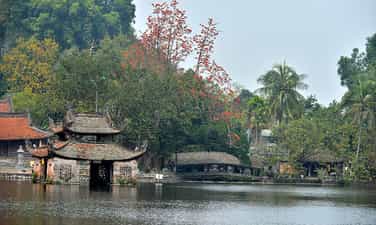
In its history, Thay Pagoda is associated with the name and life of Zen Master Tu Dao Hanh (1072 - 1117) - the 24th founder of the Vinaya Luu Chi Zen sect, with many names, such as "Huong Hai Am", "Bo De Vien", "Buddhist Tich"... Thay Pagoda and the rocky mountain areas of Sai Son, Hoang Xa, Phuong Cach, in Sai Son commune, Phuong Cach commune and Quoc Oai town, Quoc district Wow, Hanoi. This is a complex of relics combined with the landscape of low mountains in the middle of the rich plain, creating a sacred and majestic appearance, including 03 clusters of points: Sai Son rocky mountain area, Hoang Xa , Phuong Cach; Thay Pagoda relic complex; relics on Hoang Xa cave mountain. According to feng shui theory, Sai Mountain is considered a strange dragon (monster dragon), surrounded by 18 small mountains - "Eighteen beautiful mountains" flanking the ancestral mountain Tan Vien. However, currently there are only 11 mountains left: Sai Son, Long Dau, Hoa Son, Huong Son (Ho Son), Phuong Hoang, Ky Lan, Son Tuong, Am Giang, Ong Minh, Dong He and Hoang Xa . Among them, the most famous is Sai Son Mountain (Master Mountain), an arc about 100m high from Sai Son down to Hoang Xa with a radius of over 3km. On the mountain there are many hundred-year-old trees and many precious medicines bestowed by nature. Sai Mountain has many famous caves such as Cac Co cave, Thanh Hoa cave, Gio cave, at the top there is a fairy chess board and a flea market. In particular, Cac Co Cave is halfway up the mountain, very deep, the cave entrance is narrow, dark and slippery, to enter the cave you must have a torch. In the cave with a wide dome, a pool of human bones is still preserved - it is said that this is the place where the Lu Gia insurgents of the Zhao Dynasty failed to defeat the Western Han Dynasty. This is a complex of architectural works located at the foot and slope of Sai Son Mountain and some small surrounding mountains, including: Thay Pagoda (Ca Pagoda, Thien Phuc Tu), Boi Am Pagoda, Cao Pagoda, Thuong Temple, Long Pagoda Dau, Sai Khe Pagoda, Quan Thanh Temple. The Thay Pagoda relic complex also preserves a system of very rich and diverse relics and antiques, of many types and materials, such as stone, wood, paper, a system of worship statues, incense sticks, and horizontal panels. couplets,... typically include the Amitabha Tam Ton statue set (recognized as a National Treasure), the statue of Saint Tu in three lifetimes, the statue of Lu Gia, the Buddha of the Three Worlds, and the Buddha's lotus stone pedestal with a lion crowned in time. Ly, two-tiered lotus pedestal (Bach Hoa Dai) in the Tran Dynasty, altar in the Mac Dynasty... With particularly typical values, historical relics and artistic architecture of Thay Pagoda and the rocky mountain areas of Sai Son, Hoang Xa, Phuong Cach (Quoc Oai district, Hanoi city) have been ranked by the Prime Minister. special national relic according to Decision No. 2408/QD-TTg dated December 31, 2014./. Source Department of Cultural Heritage.
Hanoi
3013 view
Rating : Special national monument
Tay Phuong Pagoda
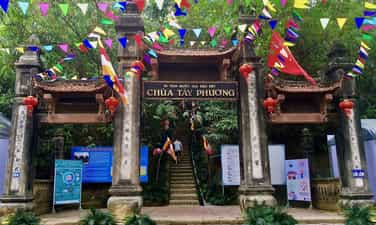
Tay Phuong Pagoda (Sung Phuc Tu, Tay Pagoda) is located on Cau Lau mountain, in Thach Xa commune, Thach That district, Hanoi city. According to some researchers, in the year Giap Dan (1554) under the reign of Mac Phuc Nguyen (1547 - 1561), the first year of Quang Bao's reign, Tay Phuong pagoda was built to the scale it is today. In the year of Canh Ty (1660), Lord Trinh Tac (1657 - 1682) ordered the pagoda to be repaired and the Three Entrances built. During the reign of King Le Huy Tong, Uy Vuong Trinh Giang also repaired the pagoda and carved more Buddha statues at the pagoda. The pagoda faces East, overlooking Dong Song mound and Kim Quy mound (Nu Rua mountain), to the West there is Tich Giang stream, to the South there is Elephant Mountain, to the Southeast there is Ly Ngu Mountain, to the Northwest there is Ba Vi peak, Includes the following categories: Lower Tam Quan, Tam Quan Tay Phuong Pagoda is a cultural heritage with special value expressed through top architectural art (in terms of geometric proportions, fine arts, science), carvings, statues... from the top of the trap, the paintings Cones, armpit beams, dragon boards... are all carved with traditional decorative themes, such as: mulberry leaves, apricot leaves, lotus flowers, chrysanthemums, dragons, phoenixes, tigers... very sophisticated. The Buddha statue system is the most unique feature, this can be considered as a Buddha Statue Museum of Vietnam. The Buddha statues are made of jackfruit wood, meticulously crafted, and have the highest sculptural value in our country. Most of these statues date back to the late 18th century, while some others were carved in the mid-19th century. Among them, typical statues of Tuyet Son, Eighteen Arhats, Bat Bo Vajra... fully converge and create a deep aesthetic impression of traditional sculpture. With the special value of the monument, the architectural and artistic relic Tay Phuong Pagoda (Thach That district, Hanoi city) has been ranked by the Prime Minister as a special national monument (according to Decision No. 2408/ Decision-TTg dated December 31, 2014)./. Source Department of Cultural Heritage.
Hanoi
3090 view
Rating : Special national monument
Soc Temple
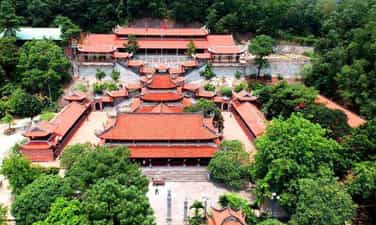
Soc Temple worships the cultural hero of Giong village who was instrumental in repelling foreign invaders and protecting the country from the dawn of national history. According to legend, King Hung built a temple to worship Saint Giong immediately after defeating the enemy. Through documentary sources, especially the epitaph of the Duong Duc era (1672), it is estimated that the temple was built around the Le dynasty before 1672. Through historical periods, Soc temple has always been preserved, repaired and embellished by the government and people. Currently, the Soc Temple relic site (International Temple) is located in Phu Linh commune, Soc Son district, Hanoi city, including items: Nghi Mon, Ha temple, Upper temple, Dai Bi pagoda, Mau temple, guest house. , sub-area, Non pagoda. Soc Temple currently preserves 145 valuable artifacts, dating back to the Le Dynasty, focusing on the Nguyen Dynasty, typically: horizontal panels, parallel sentences, stone stele, incense burners, worship statues, incense burners, altar throne, precious bowls, candlesticks, wooden horses, bronze bells... Especially the octagonal stele of the Le Dynasty built on the mountain, behind Thuong temple, is a highly valuable work of art, providing a lot of information. about Thanh Giong and local customs and traditions through the ages. Soc Temple Festival is the existence of many layers of culture and beliefs that are preserved and handed down to this day. These are the beliefs of worshiping natural phenomena - the footprints of Mr. Dong - the god of thunder and thunderstorms, the belief of worshiping the sun god, the belief of fertility, the belief of worshiping stone trees - an ancient belief of the Vietnamese people. ... Soc Temple Festival is held from January 6 - 7 (commemorating the transformation day of Saint Giong) containing many multi-faceted, unique and typical cultural values of the nation. In 2010, UNESCO honored Giong Festival as a representative intangible cultural heritage of humanity. With the special value of the monument, the Soc Temple architectural and artistic relic (Soc Son district, Hanoi city) was ranked by the Prime Minister as a special national monument (in Decision No. 2408/QD- TTg dated December 31, 2014)./ Source Department of Cultural Heritage.
Hanoi
3078 view
Rating : Special national monument
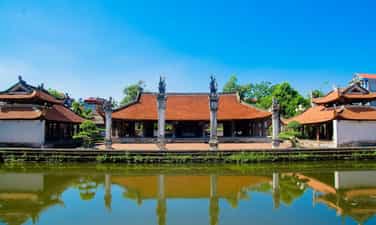
Tay Dang Communal House
Tay Dang communal house relic is located in Dong village, Tay Dang town, Ba Vi district, Hanoi city. Tay Dang Communal House worships the Three Immortals of Tan Vien Son Thanh, the top deity of the Four Immortals in the Vietnamese pantheon, a cultural hero, a national hero, a water-ruling hero who is revered by the people as Nam Thien Thanh To, He was ordained by the kings as the Supreme Spirit. Tay Dang Communal House, a typical relic among the ancient communal houses, is famous nationwide for the song "South Bridge, North Pagoda, Doai Communal House". The communal house is located on a beautiful, high land in the center of Tay Dang village, leaning back is the residential area of Dong village, in front facing the majestic Ba Vi (Tan Vien) mountain. Tay Dang Communal House includes the main items: Communal gate, semicircular lake, Nghi Mon gate, left and right moc, great communal house and communal well. These architectural items are blended together within the walled relic campus, with high and low houses and ancient curved roofs alternating together. Tay Dang Communal House has a rectangular-shaped floor plan, with a direct view of Tan Vien Mountain in front. The communal house faces south. Tay Dang communal house has a moderate size, rectangular shape, three compartments and two large wings, roofed with funny-nosed tiles. Through an overall survey, the architectural frame of Tay Dang communal house is made of jackfruit wood. This material is probably influenced by the pagoda, as if to remind of a holy, pure, enlightened spiritual land... Regarding the floor structure, the great communal house is structured with 6 rows of wooden pillars, A total of 48 large and small columns support the architectural frame. Corresponding to the compartments are 4 sets because the main roof support is designed uniformly in the style of a "gong rack". The harem is the mezzanine altar behind the two columns, in the middle space. Tay Dang communal house relic was ranked as a special national relic by the Ministry of Culture, Sports and Tourism according to Decision No. 2383/QD - UBND dated March 29, 2013. Source Electronic information portal of Ba Vi district, Hanoi city.
Hanoi
3068 view
Rating : Special national monument
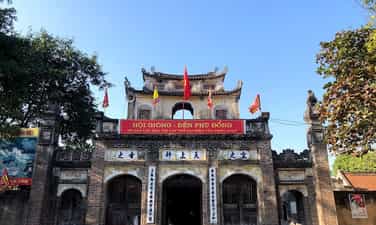
Phu Dong Temple
Historical and artistic architectural relics of Phu Dong temple (Phu Dong temple historical relic area, Giong temple historical relic area) located in Phu Dong commune, Gia Lam district, Hanoi city, have been approved by Prime Minister. The Prime Minister decided to classify it as a special national monument in 2013. The historical and architectural artistic relics of Phu Dong temple include 8 component relics, distributed in 3 villages of Phu Dong commune, with a total area of 60,343.7m2. 1. Thuong Temple (Phu Dong Thien Vuong Temple), is the main temple, facing south, overlooking the Duong River dyke. The temple includes the following functions: water pavilion, five-door gate, pavilion, front hall, middle hall, harem, left and right moc, Giam house, three-compartment house, guest house, and shop house. The water pavilion is located in the middle of the communal pond, in front of the temple, with a square floor plan, with two floors, 8 roofs, and tiled roof. The sets have the structure of stacking gong racks and horizontal roofs, divided into upper and lower thirds. The roof system rests on 4 rows of pillars. The five-door gate (five doors) with 3 main doors and 2 side doors, has a massive appearance like a city gate, built of bricks, the door frames are arched, the doors are upper and lower. . Above the gate is a 2-story, 8-roof building. Phuong Dinh is a 2-storey building with 8 roofs, tiled roof, square floor plan, roof and strips covered with lemon flowers, geometric patterns, 8 corner blades decorated with leaf shapes. The roof frame system is supported by 4 rows of columns, the structure is in the form of an upper beam and a lower cone. The front altar consists of 5 compartments, 2 porches, gabled walls, two-story match-style roof, roof system supported by 6 sets of wooden rafters, of which, 4 sets of rafters in the middle are structured in the form of upper and lower ridges, 2 sets of rafters. Because of the style of high price gong, low price, seven porch. Trung Te consists of 5 rooms, 2 shelves, the roof is covered with funny-shaped tiles, the roof is covered with strips of nails, the two gables are built with walls, the front and back are left blank, the frame includes 6 sets of wooden railings and pillars. on 6 rows of column bases, 4 middle pillars in the style of upper ding, lower and lower, 2 sets of pillars on the sides in the style of upper gong, lower con, and seven porches. The harem has an architectural plan in the shape of the letter Cong, including the outer palace, the tube and the harem. The left moc and right moc are 2 rows of houses, each side has 9 compartments, gabled walls, funny-shaped tiled roofs, the frame of each building consists of 10 sets because of the style of upper gong rack, lower cone, and seven porches. The guest house has a Nhat-shaped floor plan, gable walls, a table-top door system, and stylized leaf dragons on both ends of the roof. The frame consists of 4 sets of rafters, structured in the style of stacking gong racks, and the roof is divided into diaphragms like Thuong Tam and Ha Ngu. The roof frame system rests on 3 rows of columns. The Giam house has a U-shaped floor plan, including the main palace and two rows of houses on both sides. The main palace consists of 5 rooms, 2 chairs, a tiled roof, 6 sets of wooden rafters structured in the style of an upper gong stand, a lower seat, seven porches, resting on 6 rows of pillars. 2. Ha Temple, also known as Mau Temple, facing West, located outside the Duong River dike, includes items: ritual gate, left - right temple and main architecture in the shape of Tam, including altar, middle priest and harem. The ritual gate consists of 3 arched doors. Above the main door (middle) is a building with 8 roofs. Left - right moc, each side has 5 compartments, 2 porches, gable walls, funny-shaped tiled roofs, each building's frame consists of 6 sets of wooden beams, structured in the style of upper gong racks, lower cones, bearings on 6 rows column foot. The front altar consists of 5 compartments, 2 wings, four roofs with 4 curved leaf-shaped blades, the edges are attached with stylized pliers, the two roof trusses are covered with two rectangular dowels, next to them are attached dragon heads flanking the roof edges. , roof tiled with funny nose. The middle altar consists of 5 compartments and 2 wings, with the same architectural structure as the front altar. The harem consists of 5 rooms, 2 shelves, gabled walls, a tiled roof, a frame of 6 sets of wooden beams, structured in the style of upper and lower beams, resting on 6 rows of pillars and horizontal roofs. divided into upper third, lower fourth. 3. Ban Temple, located about 200m from Thuong Temple, inside the Duong River dyke, includes ritual gate, left - right vu, yard, main architecture in the shape of the letter Dinh. Nghi Mon consists of 2 floors, with 4 match-stacked roofs, covered with funny-nosed tiles. The middle of the roof is decorated with a sun image, the edge of the roof and the edge of the strip are decorated with lemon flower shapes, and the four corners of the knife are all decorated with stylized dragon heads. The lower floor has a gable wall shaped like a throne and a tiled roof. The house has 2 compartments on each side, with 3 sets of rafters, and is structured in the style of upper and lower gongs, and the horizontal roof is divided into upper two and lower three styles. The front hall consists of 7 compartments, the gable wall is shaped like a throne, the roof is covered with funny-nosed tiles, the roof is decorated with lemon flowers, in the middle is a scroll shaped like a tiger, the two gables are covered with two Japanese squares. , at the position of the pliers, attach the two dragon heads facing the middle of the roof. The frame consists of 8 sets of rafters, structured in the style of upper beams, lower beams or upper beams, lower beams, resting on 8 rows of columns. The temple is a 1-compartment, 2-wing house, behind the altar, combined with the altar to form an architecture with a Dinh-shaped floor plan. This building is built in the style of a gable wall, the frame system has 2 sets of rafters, is structured in the form of upper and lower panels, resting on 2 rows of column bases. 4. Ha Ma communal house, located to the left of Thuong temple, has an area of about 200m2. Currently, only the foundation remains of this structure, the communal house has been destroyed due to lack of repair. 5. Co Vien, also known as vegetable garden or eggplant garden, is located on the riverbank, about 500m from Ha Temple. Legend has it that Giong's mother went to this garden to pick vegetables, then planted them in the giant's footprints, came home pregnant, and gave birth to Giong. There is a small temple here, with a 2-story structure, 8 roofs, and 4 open sides. Next to it is a stone with a special shape, with many protrusions and concave spots, considered the footprints of giants and a stele bearing the words "Dong Thien Vuong Thanh Mau Co Trach". 6. Gia Ngu, newly restored in the early 20th century, is located on the other side of the dike, between the Upper and Lower temples. The Gia Ngu entrance gate has 2 pillars about 6m high, the top of the pillar is covered with Nghe statue, the bottom is covered with square dou, the lanterns are decorated with four sacred animals, four precious animals, the body of the pillar is decorated with parallel sentences. 7. Dong Dam chess area is a large field of land, located about 3 km from Thuong Temple, in Phu Dong village. This is where Giong's first battle against the An enemy took place in the association. 8. Chess yard - Soi stele, located in Phu Dong village, is the place where Giong's second battle against An invaders took place in the festival. Source Department of Cultural Heritage.
Hanoi
3022 view
Rating : Special national monument
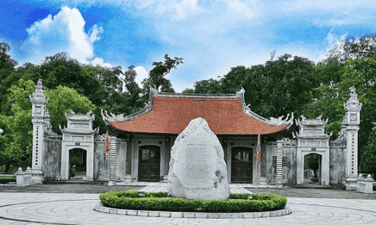
Hai Ba Trung Temple
Hai Ba Trung Temple, also known as Ha Loi Temple, belongs to Ha Loi village, Me Linh commune, Me Linh district, Hanoi city. The temple worships two martyrs - national heroes, Trung Trac and Trung Nhi - the leaders of the uprising that overthrew the rule of the Eastern Han Dynasty in 40 - 43 (AD), regaining independence. , national autonomy. Located on a high, wide area of land, overlooking the Red River dyke, with an area of 129,824.0m2, the temple includes the following items: temple gate, guest house, outer gate, inner gate, drum tower, bell tower, left house. - Huu Moc, Temple of Hai Ba Trung, Temple of Hai Ba's father and mother, Temple of Mr. Thi Sach's father and mother, Temple of female generals of Hai Ba Trung Dynasty, Temple of male generals of Hai Ba Trung Dynasty , memorial stele house Comrade Truong Chinh's secret mailbox, semicircle lake, elephant eye lake, elephant trunk stream, elephant bathing lake, Me Linh ancient citadel... - Temple gate: built on 2 floors, the lower floor has 3 arched doors, the upper floor is built in a matchlock style, with 2 floors and 8 roofs. The roof is decorated with the shape of a pair of dragons flanking the sun, the neck of the match is decorated with a 4-petal flower, the corners of the knife are decorated with fire leaves, the corner of the column is decorated with a chrysanthemum, and the body of the column is shaped with flowers and leaves. - Guest house: consists of 7 rooms, built in the style of a gable wall. - External ritual gate: built in the style of bronze pillars, also known as four pillars. The top of the pillar is decorated with four phoenixes in the style of flipped leaves, and the lantern boxes below are decorated with four sacred animals. The four-pillar system is divided into one main gate and two auxiliary gates. - The inner gate: consists of one room, two shelves, with a roof edge and a strip edge covered with lemon flower shapes, on both sides of the gable are two dragon heads, the bend is covered with two ceramic pigs in adoring position, four corners. The swords are curved, the rafters supporting the roof are made in the style of "the top stacks the beam, the bottom one passes". - The bell tower and drum tower: the drum tower and the gong tower are all made in the style of four curved roofs, the edges are covered with lemon flower shapes, the two gables are covered with tiger shapes, the upper floor opens with four doors facing four directions.. . - Hai Ba Trung Temple: + The front altar consists of 7 compartments, 2 shelves, built in the style of a gabled wall, the roof is covered with a nail style, the two ends are shaped like a dou, the ends of the two banks are shaped like a phoenix dance. In front of the altar is a pair of stone elephants in a kneeling position. Two small gates with roofs made in the style of "stack of matches", curved roofs. Connecting the two small gates are two "feng wings" paintings, in front of which there are symbolic pillars, the top of the pillar is shaped like a rooster, and the lanterns are embossed with four sacred animals. + Trung Te house consists of 5 compartments, 2 shelves, built in the style of a gabled wall, the roof is covered with a lemon flower shape, in the middle is a tiger-shaped roof, two match-stacked roofs... in front of the middle te is a stone incense burner... + Connected to the middle space of Trung Te is the harem - a three-compartment, one-room house, built vertically, combining with Trung Te to form an overall architecture in the shape of the letter Dinh. The frame supporting the harem roof consists of four sets because it has the structure of "the upper gong price, lower the beam, and "the upper gong price, lower the lower". The rows of columns are 35cm in diameter, with the letters Tho and flowers and leaves carved on the armpits. - The temple worshiping Hai Ba Trung's father and mother: has a Dinh-shaped floor plan, including an altar and a harem. The front altar consists of a 5-compartment house, built in the style of gabled walls, the roof is covered with two dragons flanking the moon, and the banks are shaped like nails. The harem consists of 1 room and 2 rooms. - Temple to worship Mr. Thi Sach's father and mother: located on the left side of Hai Ba Trung temple. The temple faces southwest, has an architectural plan in the shape of the letter Dinh, including an altar and a harem. - The Temple of the Female Generals of Hai Ba Trung Dynasty: has a monogram-shaped floor plan, including 5 compartments, built in the style of a gable wall. The two side rooms have Tho-shaped doors to bring light to the relic. The roof support system consists of 6 sets because it is structured in the form of "upper gong, middle middle, lower porch, back wall". In the middle of the altar, a high pedestal is built with thrones and tablets, and in front is an incense burner. - Temple to worship the Southern generals of the Hai Ba Trung period: facing Northeast, with a Nhat-shaped architectural plan, including 5 compartments, gabled walls, with 6 sets because it is structured in the form of "upper gong stand, middle gong". transmit, lower the seven porches, and the back wall. In the middle of the altar, a high pedestal is built with altars and tablets. - Left/right moc house: is a 7-compartment house, built in the style of gabled wall, roof edge, strip edge covered with lemon flower shape, roof support system is structured in the form of "upper gong price overlaps beam, middle, lower trap". In front of the porch on the right side of the temple are decorated 8 elephants, horses, and lions, inside are displayed some relics excavated at Me Linh ancient citadel. - Me Linh ancient citadel: there are still traces of the ancient citadel built with earth, shaped like a "curving snake", 1,750m long, with the widest part being 500m, the narrowest part being 200m, covered with refined soil, about 1 meter thick. (about 2m), 1 truong high (about 4m). Surrounding the edge of the citadel is a sarcophagus 2 meters thick (about 4 meters), 1 truong high (about 4 meters). The distance between the citadel and the sarcophagus is a "thong cu" road 2 miles wide (about 4 meters). Because of this "through and through" road, the citadel is called "Ong Citadel". The outermost circle is a trench filled with bamboo poles. Legend has it that in the past, there was the palace of Trung Vuong inside the citadel, and outside the citadel there were military and naval camps. Currently, there are remains of military posts of female general Lu Nuong and male general Bach Trach in front of Ha Loi temple, in Trang Viet commune. This is the land of Phan Lo, Chu Dien district, where Hai Ba Trung built the capital. The ancient citadel has been archaeologically excavated and many valuable artifacts have been recovered. - The memorial stele house of Comrade Truong Chinh's secret mailbox: built with four roofs, the roof corners are curved, in the middle is a souvenir stele with the content: ''Here there is an old silk tree with a hollow trunk that is a box. Secret letter from comrade Truong Chinh - General Secretary of the Communist Party of Vietnam in the years 1943 - 1945, comrade Truong Chinh took Hai Ba Trung temple as one of the secret meeting places to prepare for the general uprising. took over the government of Hanoi capital on August 19, 1945''. - Elephant's eye, elephant's trunk, elephant bathing lake, semicircular lake: Legend has it that this temple was built on land with the shape of an elephant's head, so it has the above names. This area is currently embanked with stones and bricks, surrounded by lotus flowers decorated with green stones to create a landscape for the relic. Hai Ba Trung Temple is also a place to store many precious relics, diverse and rich in both types and materials such as: wood, stone, bronze, porcelain, paper,... of which wooden relics make up the majority. Relics dating back to the Nguyen Dynasty such as horizontal panels, incense burners, grand letters, parallel sentences, coffins, palanquins, worship statues... are elaborately and exquisitely carved, with decorative themes: dragons, clouds, and statues. flowers, leaves, seals, tiger talismans... These are works of art that demonstrate the talented, skillful and sophisticated hands of our ancestors in the art of creation, reflecting many aspects of social life and dreams. hope for a better life. The relic has been ranked as a special national relic by the Prime Minister (Decision No. 2383/QD -TTg, December 9, 2013). Source Department of Cultural Heritage.
Hanoi
3370 view
Rating : Special national monument
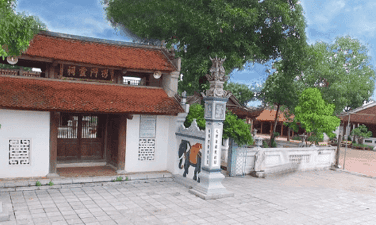
Hat Mon Temple (worshiping Hai Ba Trung)
Hat Mon Temple, also known as International Temple, Hai Ba Trung Temple, is located in Hat Mon commune, Phuc Tho district, Hanoi city. According to some recorded documents, the Hat Mon area was where Hai Ba Trung organized their soldiers' association after meeting in Phong Chau citadel. This is also the place where Hai Ba Trung died when the uprising failed. Legend has it that Hat Mon Temple was built after Hai Ba Trung reincarnated into the eternal realm. The temple faces southwest and includes the main architectural works: Tien Quan, Temporary Temple, Ritual Gate, Phuong Communal House, Oath altar, three gates, front altar, middle hall, harem, left and right moat, Hidden mound, Mrs. Nguyen Thi Dinh's memorial house, guest house, annex... Quan Tien: is a small structure, built of brick, the door opens towards the temple in a rolling dome style, has a curved roof, the floor is 45cm higher than the road surface, creating three steps to the restaurant floor. According to the village's fairy tale, this place was originally a shop selling floating cakes. When Hai Ba Trung's insurgent army gathered at the Oath altar, the lady who sold floating cakes offered a whole load of cakes for the Two Ladies to eat before going into battle to defeat the enemy. This small shop was built by the villagers to commemorate their gratitude to the floating cake vendor. Temporary Temple: located in front of the right side of the main temple, has a Dinh-shaped plan, including an altar and a harem. The three-compartment altar house has gable walls, a tiled roof, and a nail-shaped roof. The sets have a structure like "the gong stand, the lower part and the seven verandas". The three-compartment harem building is built connected to the front altar. The roof support system has the same structure as the front altar house. The front opens with a table-style door system. This architectural work is the temporary residence of the Holy Lady. During the annual flood season, the main temple area is flooded, the villagers process the statue, the throne and all the temple's worshiping objects to the Temporary Temple. At the end of the flood season, they process the Holy Palace again. The outer ritual gate: dating back to the Nguyen dynasty, is made in the style of four brick pillars, the top of the pillar embossed with four phoenixes and unicorns. The lantern part is embossed with four sacred animals (dragon, lyre, tortoise, phoenix). The pillar body has parallel sentences in Chinese characters. From the gate, following the dike slope down is the main temple area, on the right there is a lake, in the middle of the lake is a recently built water house (Phuong communal house). On the left side of the road on the dike surface is the memorial house for female general and heroine Nguyen Thi Dinh. Swearing altar: newly built in front of the three-entrance gate, the swearing stone pillar is shaped like a tower-shaped pillar, four sides are engraved with Chinese characters, placed on a foundation 65cm higher than the yard level, with five steps, facing the engraved temple. content of Hai Ba Trung's oath. Surrounding the altar is a mezzanine wall, outside of which are placed stone statues of elephants and horses. Ritual Gate: consists of three match-stacked compartments, two-storey roof. The three doors entering the temple are made of planks. The roof support beams are structured in the form of "gong racks, lower panels, seven porches", the roof is tiled, and the floor is tiled with Bat tiles. Stele houses: two stele houses were built on the outside of the left/right row of houses, on a foundation 30cm higher than the yard level, in the style of a communal house, with tiled roofs and four curved blades. Left/right desert: each row of five compartments runs along the temple yard, gabled wall style, tiled roof, roof support structures in the form of "gong rack, lower and lower", placed on the wall to add a pillar to hide. colonnade. Dai worship house: consists of five compartments, built with bricks in the style of gable walls, the roof supports are structured in the style of "upper price gong, overlapping beams, con me, seven porches", the roof rafters are divided "upper third - lower fourth", The roof is tiled, the floor is Bat tiled. Decoration on the architecture is densely concentrated on the ends, pillars, armpit beams, traps, wind panels in the form of embossed, filigree..., with themes of dragons and four sacred animals. This is an artistic product from the Le Trung Hung period to the Nguyen dynasty. The middle room is hung with horizontal panels, and the pillars are all hung with parallel sentences praising the merits of the Hai Ba. The front altar: consists of five rooms, built with bricks in the style of a gable wall, the floor is 30 cm higher than the yard level, surrounded by a bunch of bricks, the structures are "upper porch, gong rack, lower porch". The harem: consists of three rooms, built on a foundation higher than the yard level, with gable walls and a tiled roof. The roof of this building is connected to the middle building through the roof of the bridge. The wooden frame supporting the roof consists of four sets of "stacked" trusses. The decoration on this architecture is mainly phoenix. The middle space of the forbidden palace was created with a wooden box covered with wooden planks, which was the place to worship the Hai Ba. Guest house: consists of five rooms, with gable walls. The sets of rafters supporting the roof create the style of "gongs at the top, low down, seven porches" with hidden columns. Hidden Mound: behind the temple's harem. Legend has it that this is the vestige of the place where Hai Ba Trung hid the seal before withdrawing and reincarnating into eternity at the mouth of the Hat River. Currently, Gia An Mound is bordered and surrounded by brick walls. Hat Mon Temple also preserves many relics and antiques of cultural and historical value, including: 293 relics and antiques with many types and rich materials, such as wood, stone, bronze, porcelain. , paper, metal... dating from the Le, Tay Son, Nguyen dynasties to the present. Hat Mon Temple Festival is held every year on March 6 (lunar calendar), with rituals and folk performances attracting a large number of local people and visitors. In particular, the custom of making banh troi and the procession of banh troi offering to Hai Ba has become a unique cultural activity of this land. During the anti-French and anti-American era, Hat Mon Temple was chosen as a living and training place for local militia and guerrillas. Historical events and the system of relics around the Hat River area contribute to enriching the content and enhancing the value of Hai Ba Trung temple. With special values, Hat Mon Temple relic (Phuc Tho district, Hanoi city) has been decided by the Prime Minister to rank as a special national relic (in Decision No. 2383/QD-TTg dated September 9). /December 2013). Source Department of Cultural Heritage.
Hanoi
3451 view
Rating : Special national monument